ETLFlow — ETL pipelines with Airflow 3.0 and Spark
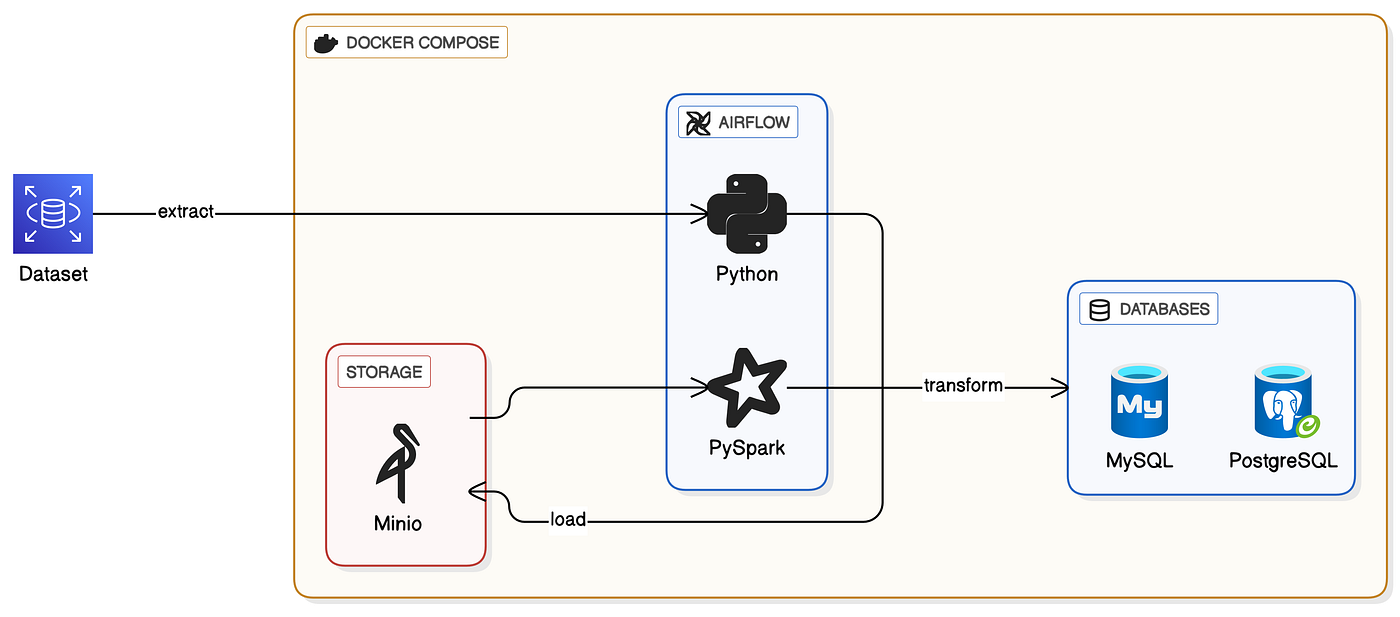
ETLFlow is a complete ETL stack you can run on your laptop with Docker Compose. It puts Apache Airflow 3.0, Spark, Kafka, MySQL, Postgres and MinIO in one project, and the pipeline does the full job: pull rows out of MySQL, validate them, transform them with Spark, and load the result into Postgres.
It is built to show how these tools fit together in practice — service dependencies, environment configuration, health checks — without needing a cloud account or a cluster.
Three Make commands start everything: make env creates your .env file, make build builds the Airflow image, make up starts the stack. The custom image is Airflow 3.0.6 with Java and PySpark installed, so Airflow can submit Spark jobs itself.
Airflow runs as five containers (API server, scheduler, DAG processor, Celery worker, triggerer), with Redis as the broker and Postgres for metadata. Every service has a health check, so the stack comes up in the right order. MySQL starts with a sample orders table; Postgres has a jobs database where results land.
When it is up: Airflow at localhost:8080, Spark UI at :9090, MinIO at :9001, PGAdmin at :8050, Postgres at :5432.
batch_ingest runs the pipeline in five steps: read the orders table from MySQL, check it against a Pandera schema, write the CSV to the MinIO raw-data bucket, run spark_batch_job.py to deduplicate and aggregate, then save Parquet and load it into the Postgres orders_transformed table.
sparking_flow submits Spark jobs from Airflow with SparkSubmitOperator — a Python job and a Java job built with Maven, plus an optional Scala example. This is the part that proves Airflow can drive Spark, not just Python tasks.
Airflow 3.0 (CeleryExecutor) · Spark (Bitnami) · Kafka + Zookeeper · MySQL 8.0 · Postgres 16 · MinIO · Redis · Pandera · Docker Compose · Make. MIT licensed. Setup is written up in a Medium post; the repo README covers the DAGs and data flow.